


Which Cable Material Is Suitable for Your Project? XLPE or XLPO?
A solar power system’s long-term success depends on parts that are sometimes disregarded, including solar wires, in addition to modules and inverters. A Solar Cable‘s construction and insulation material have a direct impact on system efficiency, operational safety, and service life because they serve as the physical conduit for the transfer of power.
Solar Cables are nearly typically put outside in practical applications. For decades, they are subjected to mechanical stress, moisture, temperature fluctuations, and sunshine. However, the climate in which solar plants operate varies greatly. While some are situated in tropical or desert regions with high ambient temperatures and severe UV radiation, others are erected in frigid climates with below-freezing winters.In these circumstances, insulation performance stops being a minor aspect and starts to play a major role.
At present, the most commonly used insulation materials for solar PV cables are XLPO (cross-linked polyolefin) and XLPE (cross-linked polyethylene). Both are widely applied in the industry, but they differ clearly in material behavior, cost structure, and suitable use scenarios.
Why Insulation Material Is Critical in Solar Cable
The insulation layer serves as the primary protection for the conductor. Its quality affects several key aspects of cable performance:
- It protects the conductor from UV exposure and heat-related aging, which are major causes of insulation cracking in outdoor cables.
- It helps maintain stable electrical performance over a service life of 25 years or more, which is the typical design life of PV systems.
- It prevents mechanical failures such as hardening, brittleness, or surface cracks, especially under temperature cycling.
- It ensures sufficient flexibility during installation, reducing the risk of damage when cables are pulled, bent, or routed through limited spaces.
If insulation material is poorly selected, the consequences are well known in practice: higher power loss, insulation breakdown, increased fire risk, and frequent maintenance or replacement. These problems are particularly common in harsh outdoor environments.
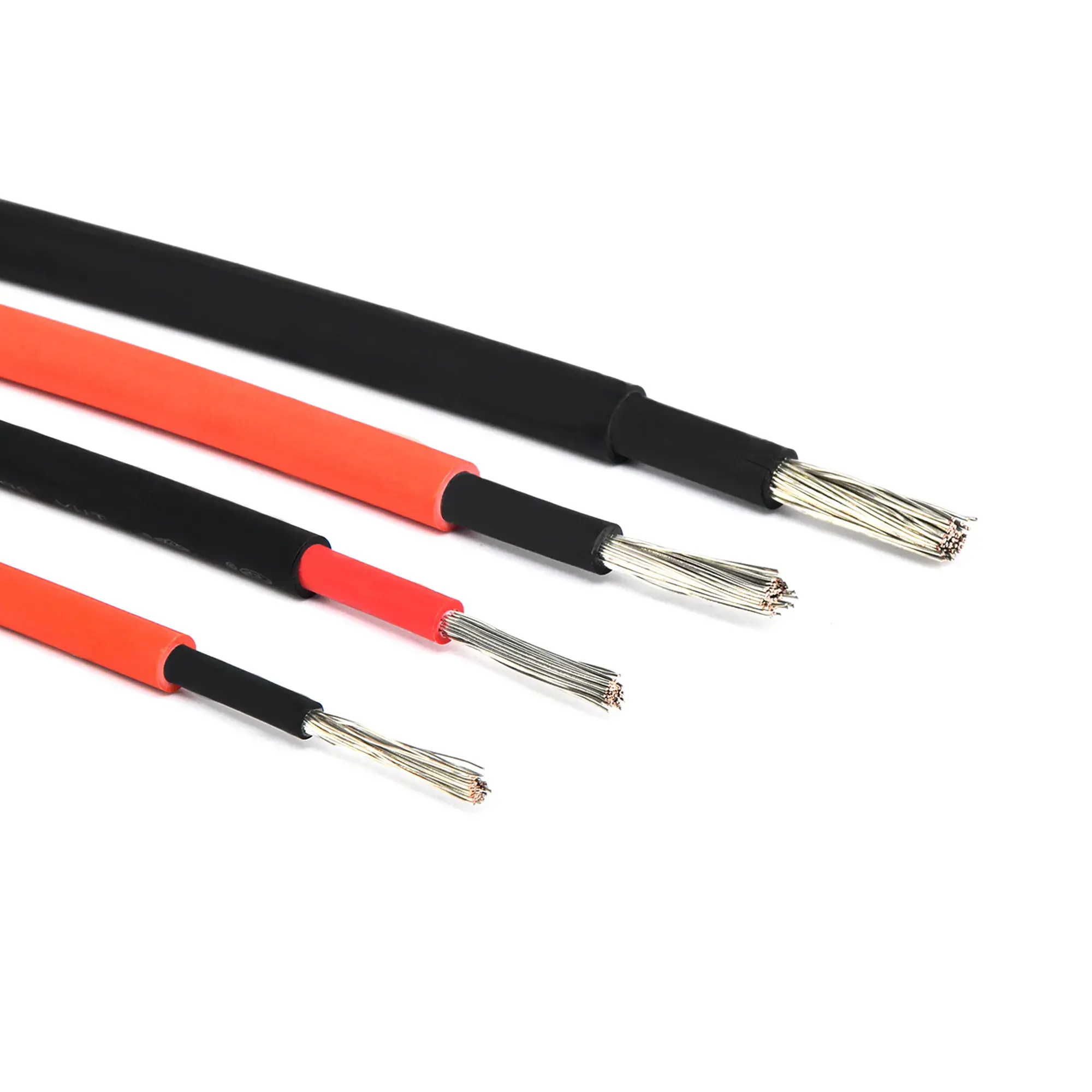
XLPO Insulation: Flexible and Highly Resistant to Environment
XLPO insulation is often used in higher-specification photovoltaic cables because of its excellent flexibility and weather resistance.
From a material perspective, XLPO has a molecular structure that allows the cable to remain flexible even at low temperatures. This is especially important in projects where cables must be bent repeatedly or installed in narrow spaces, such as rooftop systems or dense cable trays.
Main Characteristics of XLPO Solar Cables:
- Maintains flexibility even in cold climates, reducing installation stress
- Provides very strong UV resistance, slowing down aging under long-term sunlight
- Can operate at conductor temperatures up to 125°C, suitable for high-load conditions
- Resists ozone, weathering, and long-term outdoor exposure
In practical terms, these properties make XLPO cables easier to install and more stable in environments where temperature variation and solar radiation are severe.
Typical Use Scenarios:
- Utility-scale solar power plants with long outdoor cable runs
- Rooftop PV systems where routing is complex
- High-UV regions such as Africa, the Middle East, and Southeast Asia
- Installations requiring frequent bending or compact cable layouts
Main Characteristics of XLPO Solar Cables:
- Maintains flexibility even in cold climates, reducing installation stress
- Provides very strong UV resistance, slowing down aging under long-term sunlight
- Can operate at conductor temperatures up to 125°C, suitable for high-load conditions
- Resists ozone, weathering, and long-term outdoor exposure
In practical terms, these properties make XLPO cables easier to install and more stable in environments where temperature variation and solar radiation are severe.
Typical Use Scenarios:
- Utility-scale solar power plants with long outdoor cable runs
- Rooftop PV systems where routing is complex
- High-UV regions such as Africa, the Middle East, and Southeast Asia
- Installations requiring frequent bending or compact cable layouts
XLPE Insulation: Strong, Stable, and Cost-Efficient
XLPE insulation is widely adopted in commercial and industrial solar projects due to its thermal stability, mechanical strength, and economic advantages.
XLPE performs reliably under continuous operating temperatures of around 90°C, and it can tolerate short-term temperature spikes of up to 250°C. This makes it suitable for environments where cables may experience temporary overloads or localized heat accumulation.
Another practical advantage of XLPE is its strong resistance to chemicals, oils, and industrial pollutants, which explains its frequent use in factories, warehouses, and industrial parks.
Main Characteristics of XLPE Solar Cables:
- Stable performance under long-term thermal stress
- Excellent resistance to chemicals and oils
- High mechanical strength and durability
- Lower material cost compared with XLPO insulation
Although XLPE is slightly less flexible than XLPO, this limitation rarely causes problems in standard installations where extreme bending is not required.
Typical Use Scenarios
Industrial and commercial rooftop PV systems
Solar projects in chemical plants or industrial zones
Cost-sensitive markets such as India, Africa, and South America
Residential and general commercial PV installations
XLPO vs XLPE: Practical Comparison
|
Aspect |
XLPO Solar Cable |
XLPE Solar Cable |
|
Flexibility |
Excellent |
Good |
|
UV Resistance |
Very high |
High |
|
Continuous Operating Temperature |
Up to 125°C |
Up to 90°C |
|
Short-Term Heat Resistance |
High |
Up to 250°C |
|
Chemical Resistance |
Good |
Excellent |
|
Installation Convenience |
Very easy |
Moderate |
|
Material Cost |
Higher |
More cost-effective |
This comparison shows that neither material is universally better. The optimal choice depends on project conditions and priorities.
How to Choose the Right Insulation for a Solar Project
In practical engineering decisions, insulation selection should be based on environmental conditions, installation requirements, and budget constraints.
XLPO insulation is generally more suitable when:
- The project is located in high-temperature or high-UV regions
- Cable routing involves frequent bending or limited space
- Long-term flexibility and weather resistance are key concerns
- The project targets higher performance rather than lowest initial cost
XLPE insulation is often preferred when:
- Cost control is a major consideration
- The environment includes oil, chemicals, or industrial contamination
- Mechanical strength and thermal stability are prioritized
- The system is a residential, commercial, or industrial PV installation
Although XLPO cables usually require a higher initial investment, they can reduce maintenance needs in harsh environments. From a full lifecycle perspective, this may offset the higher upfront cost in certain projects.
Manufacturer’s Perspective
As a professional solar cable manufacturer, we supply both XLPO- and XLPE-insulated solar cables manufactured in accordance with international standards such as TÜV, IEC 62930, and EN.
From project experience, early-stage material selection has a measurable impact on system reliability and long-term operating costs. Choosing insulation that matches local climate conditions and installation methods helps extend cable service life and improves overall return on investment.
For projects where the insulation choice is not clear, technical evaluation based on actual site conditions is recommended. This approach allows EPC contractors and developers to select a solar cable solution that balances performance, durability, and cost.