


Flat Cables vs. Round Cables in Photovoltaic Systems: Which One to Choose?
When designing a solar installation, cable selection impacts performance, longevity and project economics. Solar professionals typically choose between two main types: flat (ribbon) cables and conventional round cables, each serving different needs.
Flat Solar Cable Characteristics
The slim rectangular profile of flat Solar Cables offers distinct advantages. Their low-height design enables easy routing under solar panels and along mounting rails, particularly useful in space-constrained rooftop arrays. The increased surface-to-volume ratio enhances natural cooling compared to round conductors. For residential systems, their discreet appearance maintains clean aesthetics. The aerodynamic form also reduces wind-induced movement in exposed locations. Tradeoffs include reduced crush resistance and potential stress points at sharp bends.
Round Solar Cable Characteristics
The familiar circular cross-section provides inherent strength. Their symmetrical construction withstands mechanical stresses better, making them suitable for buried runs or industrial environments. Electricians find them simpler to pull through conduits due to uniform bending characteristics. As the industry standard, they typically cost less per meter and are stocked by most suppliers. The tradeoff comes in bulkier dimensions that may complicate dense panel layouts and increased wind loading in elevated installations.
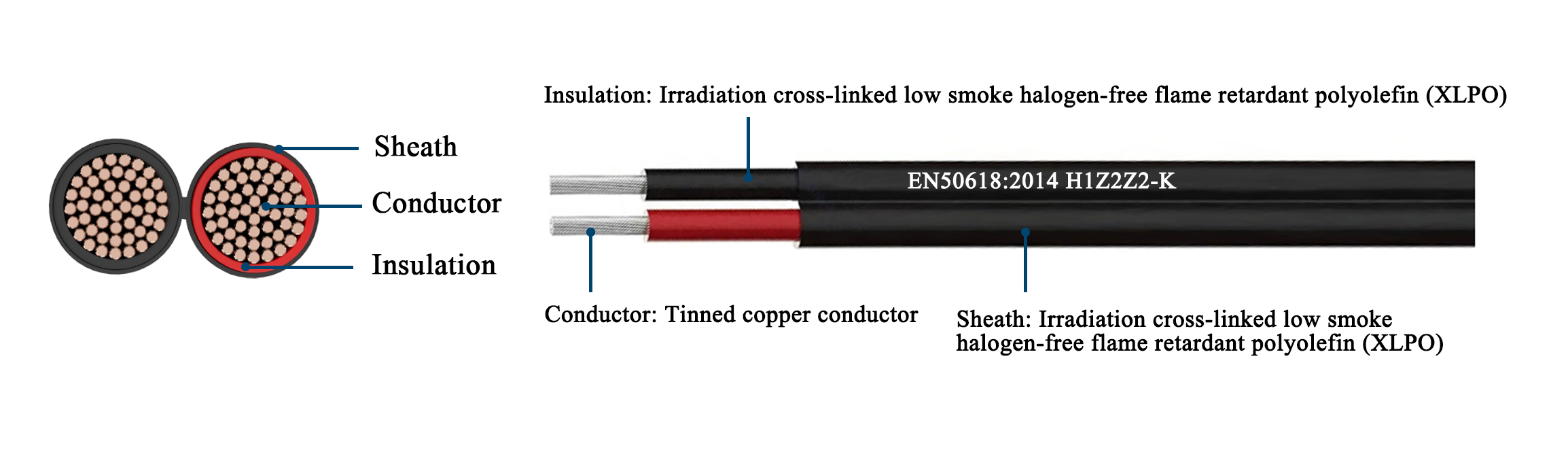
Critical Selection Criteria
(1)Installation: Flat solar cable versions simplify surface runs; round solar cable types suit conduit pathways
(2)Robustness: Round solar cables withstand harsh conditions better
(3)Thermal Performance: Comparable conductivity, with flat solar cables cooling slightly better
(4)Economics: Flat solar cables reduce labor time; round solar cables have lower material costs
(5)Ideal Applications: Flat solar cables for rooftops and visible areas; round solar cables for utility-scale fields
Implementation Considerations
Site-specific factors should guide the decision. Residential systems often benefit from flat solar cables’ discreet profile and easy installation. Commercial ground-mount systems typically require round solar cables’ durability. Environmental exposure, maintenance access and budget constraints all influence the optimal choice.
Final Recommendations
When designing a solar system, engineers need to choose the right cable based on actual needs (such as cost, installation environment, power transmission requirements, etc.). In the future, there may be more advanced cable technology that combines the advantages of the current two types. But at this stage, it is still necessary to choose the most suitable solar cable based on the specific project situation.