01
4-Level Protection
Reinforced construction designed for demanding photovoltaic environments.


*Temperature Resistance: Delivers consistent operation in both hot and cold environments.
*UV & Weather Resistance: Designed to withstand prolonged UV exposure and severe weather elements.
*Standards Compliant: Complies with UL and TUV standards to ensure top-quality reliability.
*Long-lasting: Offers exceptional longevity with minimal upkeep requirements.
*Quote Online Now, Contact Us, Free Samples Available.


Submit product, specification and quantity for review before payment.
Key product advantages are presented in a concise format for engineers, distributors and project buyers.
Reinforced construction designed for demanding photovoltaic environments.
Performance verification information can be reviewed together with the related technical documentation.
TÜV, CE, RoHS and REACH compliance information presented in one place.
Positioning focused on durability, safety and long-term project reliability.
Original product application, structure, features and technical data.
| Model | UL4703 |
|---|---|
| TECHNICAL INDICATORS | |
| Rated voltage | 600V |
| Standard | UL 4703 |
| Working temperature | -40℃~90℃ |
| Conductor maximum temperature | 120℃ |
| Short circuit temperature | 280℃ 5s |
| Bending radius | D<8mm 4D; D≥8mm 6D |
| Service life | ≥25 Years |
| STRUCTURE | |
| Conductor Material | Tinned copper |
| Insulation | Low-smoke, halogen-free, flame-retardant irradiated polyolefin |
| Sheath | Low-smoke, halogen-free, flame-retardant irradiated polyolefin |
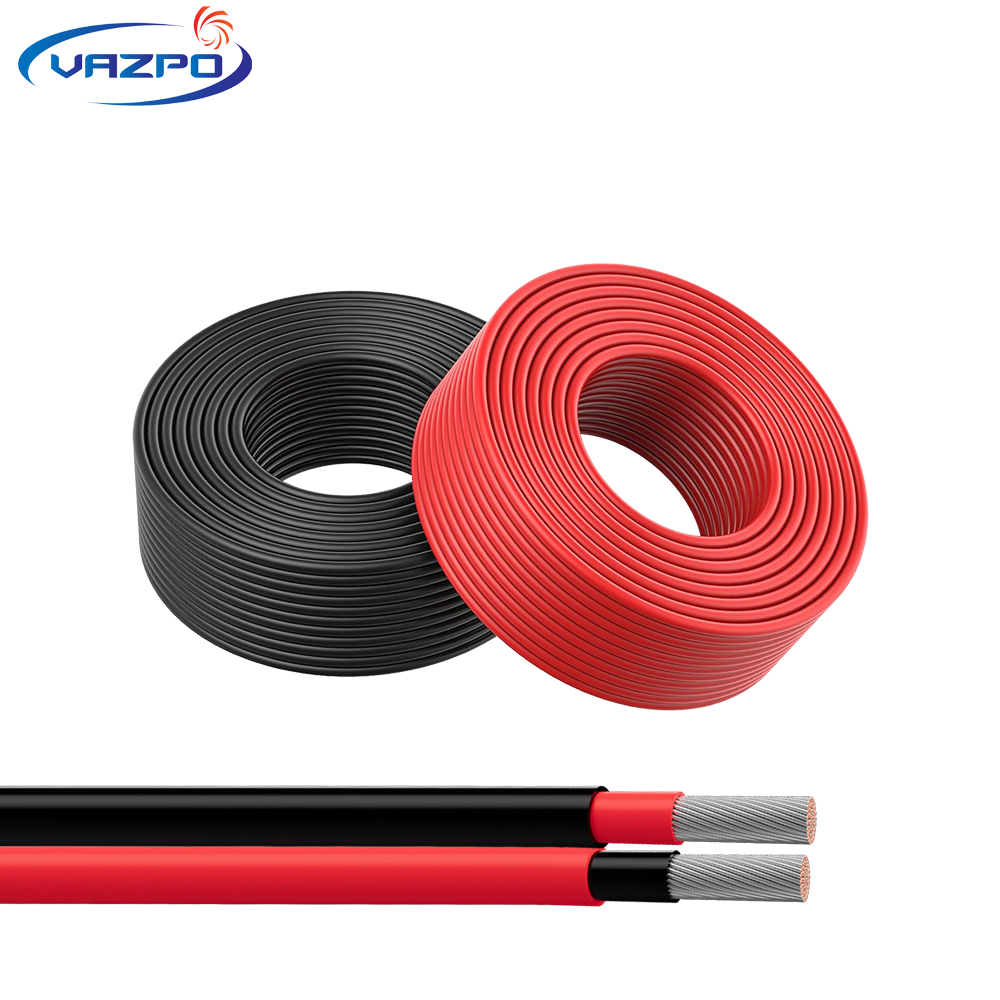
| Color | Black or Red |

| Specification | Construction Construction (No./mm+0.01) |
InsulationThickness | SheathThickness | OuterDiameter | Weight kg/km |
|---|---|---|---|---|---|
| mm | mm | mm | |||
| 1x14AWG | 30/0.25 | 1.05 | 0.76 | 4.9 | 37.7 |
| 1x12AWG | 50/0.25 | 1.05 | 0.76 | 5.43 | 52.3 |
| 1x10AWG | 56/0.3 | 1.05 | 0.76 | 6.13 | 76.2 |
| 1x8AWG | 84/0.3 | 1.25 | 0.76 | 7.69 | 120.5 |
| 1x6AWG | 142/0.3 | 1.25 | 1.14 | 9.45 | 186.3 |
| 1x4AWG | 228/0.3 | 1.25 | 1.14 | 10.66 | 266 |

PV cables for large-scale solar power generation projects.

Reliable cabling solutions for large commercial and industrial PV systems.

Durable solar cables for large ground-mounted photovoltaic installations.
| Packing Pictures | Packing/Meter | Pack Reel | Pallet Dimension(m) | Pallet/Meter |
|---|---|---|---|---|
 |
100 Meter/Roll | / | 1.12×1.12×1.1m | 16000 |
|
200 Meter/Roll | / | 1.12×1.12×1.1m | 16000 |
 |
500 Meter/Reel | Plywood | 1.12×1.12×1.1m | 12000 |
|
1000 Meter/Reel | Plywood | 1.12×1.12×1.1m | 12000 |
|
3000 Meter/Reel | Plywood | 1.12×1.12×1.1m | 12000 |


Original VAZPO certificate scans are available for buyer review. Confirm product-specific applicability with the sales team.


Real VAZPO factory, workshop and packing-area imagery.


Answers about quotations, product documents, samples, certification and project procurement.
A UL solar cable is a photovoltaic (PV) wire certified by Underwriters Laboratories (UL) to meet North American safety standards. It is specifically designed for DC solar applications, offering UV resistance, flame retardancy, and weatherproofing, making it suitable for outdoor and rooftop installations in both residential and commercial systems.
The DC 1500V UL 4703 rating means the cable is UL-certified for use in solar PV systems with voltages up to 1500 volts DC. It ensures the cable is safe, durable, and compliant with strict U.S. standards, providing reliable performance in outdoor conditions like high heat, UV exposure, and moisture.
Yes. UL solar cables are designed for indoor wiring, such as inside conduits or junction boxes, and outdoor use, where they face direct sunlight, rain, or snow.
The right gauge depends on system voltage, current, and cable run length. Shorter runs & lower current: 12 AWG is common Medium runs or higher current: 10 AWG is recommended Long runs or very high current: 8 AWG or larger Choosing the correct gauge prevents voltage drop and power loss, improving overall system efficiency.
Yes. These cables are UV-resistant, moisture-resistant, and sunlight-resistant, making them suitable for outdoor and wet locations, including coastal areas or rainy climates.
Related products from the same product category.