


Is Thicker Solar Cable Really Better? Understanding Cable Protection and Design
When selecting a solar cable for a photovoltaic project, one simple idea often comes to mind: the thicker the cable, the better the protection.
It sounds reasonable. A thicker insulation layer should provide more protection, and a thicker outer sheath should make the cable more resistant to external damage. But in practice, solar cable design is not simply a matter of making everything thicker.
For photovoltaic cable, the real question is how the conductor, insulation, sheath, material, and manufacturing process work together to provide reliable long-term performance.
As solar projects become larger and more diverse, cable requirements are also becoming more specific. A residential rooftop system, a utility-scale solar farm, and a project in a hot, humid, coastal, or desert environment may require different levels of protection.
Therefore, cable thickness should be considered as part of the overall cable design rather than as an independent indicator of quality.
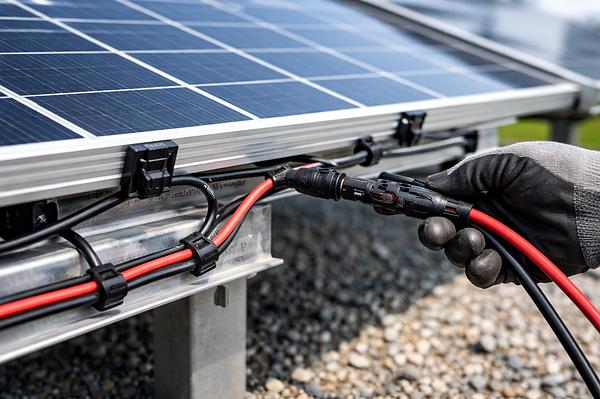
What Does “Thicker” Actually Mean in Solar Cable?
When people talk about a thicker PV cable, they may be referring to several different parts of the cable.
The first is insulation thickness. The insulation provides electrical isolation between the conductor and the outside environment. A properly designed thicker insulation layer can provide additional physical protection and help maintain insulation performance under demanding operating conditions.
The second is sheath thickness. The outer sheath is directly exposed to sunlight, rain, moisture, abrasion, and other environmental factors. Increasing sheath thickness can provide an additional layer of physical protection.
The third is the overall cable diameter. A larger cable structure may improve physical protection, but it can also affect flexibility, bending, routing, and installation convenience.
These three dimensions should not be confused.
For example, increasing the insulation thickness does not necessarily mean that the outer sheath has also been reinforced. Likewise, a larger overall cable diameter does not automatically mean that the cable has better UV resistance, temperature resistance, or aging performance.
Therefore, when comparing solar PV cables, looking at diameter alone does not tell the whole story.
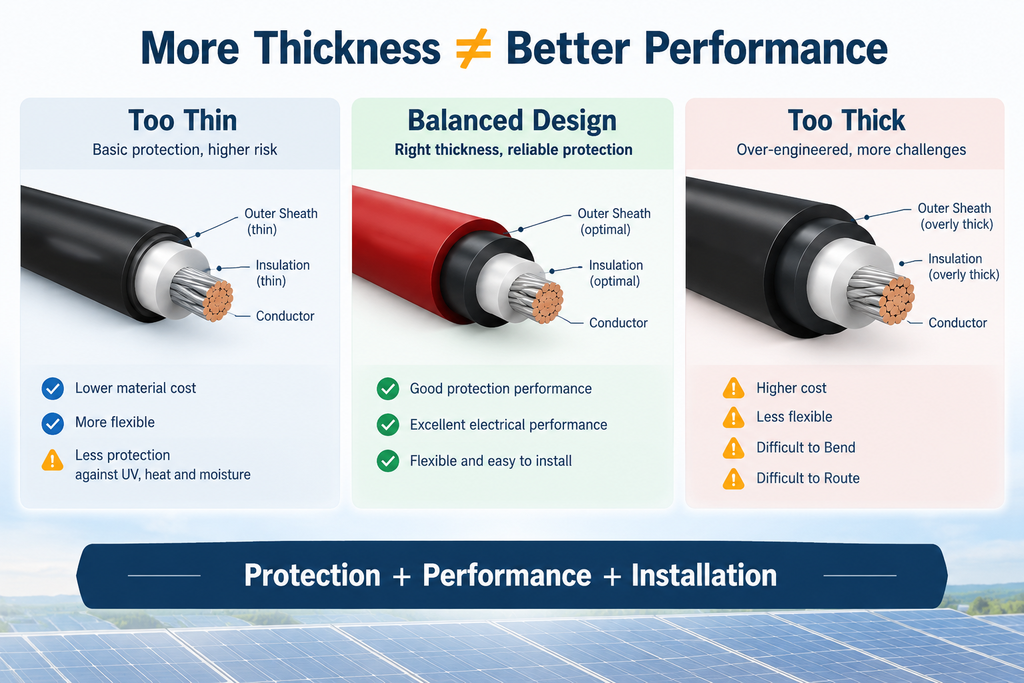
Is a Thicker Solar Cable Always Better?
Not necessarily.
A thicker cable can provide additional protection, but more material does not automatically mean better overall performance. If a cable becomes unnecessarily large or rigid, it may be more difficult to bend and install, especially around PV modules, mounting structures, connectors, and junction boxes.
For this reason, professional solar cable design needs to balance protection and practicality.
The more important question is not:
“Which cable is the thickest?”
but:
“Does the cable have the right structure and materials for its intended application?”
This is particularly important for large photovoltaic projects, where hundreds of thousands of meters of cable may need to be installed. A small difference in cable design can become significant when multiplied across a large project.
Cable characteristics can influence installation efficiency, cable routing, connector assembly, and long-term protection. At the same time, a cable that is under-protected may not provide the level of durability required by the project environment.
The objective is therefore not maximum thickness. It is appropriate protection based on the actual application.
Why Solar Cable Insulation Thickness Matters
The insulation layer plays a critical role in a photovoltaic cable.
The conductor carries electrical current, while the insulation separates the conductor from the surrounding environment and helps maintain electrical safety.
During long-term operation, the insulation can be exposed to heat, sunlight, moisture, mechanical stress, and temperature changes. These conditions make insulation quality particularly important for outdoor solar applications.
A reinforced insulation layer can provide additional physical protection around the conductor. It can also contribute to the overall robustness of the cable structure.
However, insulation performance is determined by more than thickness.
The material itself, formulation, extrusion quality, cross-linking process, and finished-product testing all influence the final result.
This is why two cables with similar insulation thickness may not necessarily have identical performance.
For professional procurement, it is more useful to consider:
Insulation thickness + insulation material + manufacturing process + testing
rather than looking at thickness alone.
Why a Thicker Solar Cable Sheath Can Be Useful
The outer sheath is the part of the cable that directly interacts with the surrounding environment.
In a typical PV installation, the cable may remain outdoors for many years. Depending on the project, it can experience strong solar radiation, rain, humidity, dust, temperature fluctuations, and physical contact with mounting structures.
During installation, cables may also be pulled, bent, routed, or exposed to friction.
A properly designed thicker sheath can provide an additional layer of physical protection against these conditions.
This is particularly relevant for projects where cables are exposed to demanding outdoor conditions.
However, there is an important distinction between thickening the sheath and simply using more material.
The sheath material still needs to have appropriate properties for photovoltaic applications. Its resistance to heat, UV exposure, weathering, and mechanical stress matters.
This is why XLPO is widely used in photovoltaic cable insulation and sheathing.
A thicker sheath with an appropriate material can provide additional protection, but thickness cannot replace material quality.
Material Matters as Much as Thickness
Thickness is only one part of cable protection. The material used for insulation and the outer sheath is equally important.
XLPO is commonly used in photovoltaic cables because of its suitability for demanding outdoor applications. Properly designed XLPO insulation and sheathing can provide resistance to heat, UV exposure, weathering, and long-term environmental stress.
This means that a thinner cable made with an appropriate material and manufacturing process may perform better than a thicker cable made with an unsuitable structure.
The same principle applies to the conductor.
Conductor design, resistance, surface protection, and electrical performance all need to be considered together with insulation and sheath thickness.
For buyers, this is why comparing only one specification can lead to an incomplete evaluation of a photovoltaic cable.
A product specification sheet may show cable diameter, insulation thickness, and sheath thickness, but these numbers should be considered together with the relevant standards, electrical data, material information, and test results.
Why Irradiation Matters for Solar Cable Performance
Another factor that is often overlooked is the manufacturing process.
Irradiation cross-linking is an important process used in many high-performance solar cables. It can improve the heat resistance, mechanical properties, and aging performance of insulation and sheath materials.
For photovoltaic applications, this process is particularly relevant because solar cables are expected to operate outdoors for long periods.
However, irradiation is not simply about passing a cable through irradiation equipment. Process control and consistency are also important.
The material characteristics, irradiation process, production conditions, and quality-control procedures need to be properly managed.
At VAZPO, irradiation is part of our own manufacturing process. With dedicated irradiation equipment and production lines, the insulation and sheath materials of our solar cables undergo controlled irradiation processing before the finished cable is tested.
This highlights an important point:
Solar cable performance comes from the combination of material, structure, and manufacturing process—not thickness alone.
Cable Protection Depends on the Installation Environment
The right level of cable protection can also depend on where the photovoltaic system is installed.
A rooftop PV system may have relatively controlled cable routing, while a utility-scale ground-mounted project can involve long cable runs and extensive outdoor exposure.
Projects in coastal areas may face high humidity and salt exposure. Projects in desert environments may experience high temperatures, dust, sand, and strong solar radiation.
These conditions can place different demands on the cable structure.
For this reason, project engineers should consider the installation environment when selecting a solar PV cable.
Important questions include:
Where will the cable be installed?
How much direct sunlight will it receive?
Will it be exposed to moisture?
Will it contact metal structures?
How much mechanical stress can occur during installation?
Will the cable be installed in a protected cable tray or exposed directly outdoors?
The answers help determine whether standard protection is sufficient or whether a reinforced cable structure should be considered.
How VAZPO Reinforced Solar Cable Approaches Protection
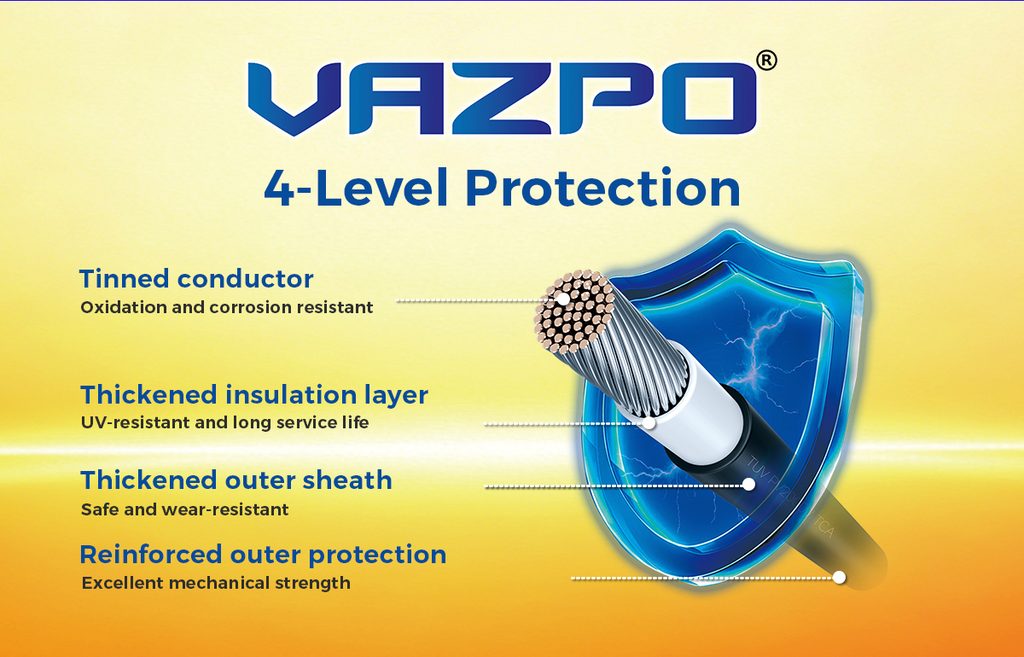
VAZPO’s Reinforced Solar Cable is designed around a multi-layer protection concept.
The design includes tinned conductor protection, reinforced insulation, a thickened XLPO sheath, and an enhanced overall cable structure.
The purpose is not simply to make the cable thicker. Instead, each layer is designed to provide a specific type of protection.
The conductor receives surface protection. The reinforced insulation provides additional electrical and physical protection. The thicker XLPO sheath provides an additional barrier against environmental exposure. The enhanced overall structure improves physical durability while maintaining practical installation characteristics.
This approach allows cable protection to be considered as a complete system rather than focusing on a single dimension.
Instead of asking:
“How can we make the cable bigger?”
the design question becomes:
“Where does the cable need additional protection, and how can that protection be built into the structure?”
This way of thinking is particularly useful for long-term photovoltaic applications.
Standard Solar Cable vs. Reinforced Solar Cable
A conventional solar cable and a reinforced solar cable should not simply be viewed as “good” versus “bad.”
They can be designed for different project requirements.
A standard photovoltaic cable can provide the required electrical and environmental performance for its intended application. A reinforced solar cable introduces additional structural protection where the project places greater emphasis on physical durability and cable protection.
For example, if cables are exposed to greater mechanical contact or demanding outdoor conditions, additional insulation and sheath protection may become more relevant.
The important point is to match the cable design with the application rather than assuming that the thickest product is automatically the best choice.
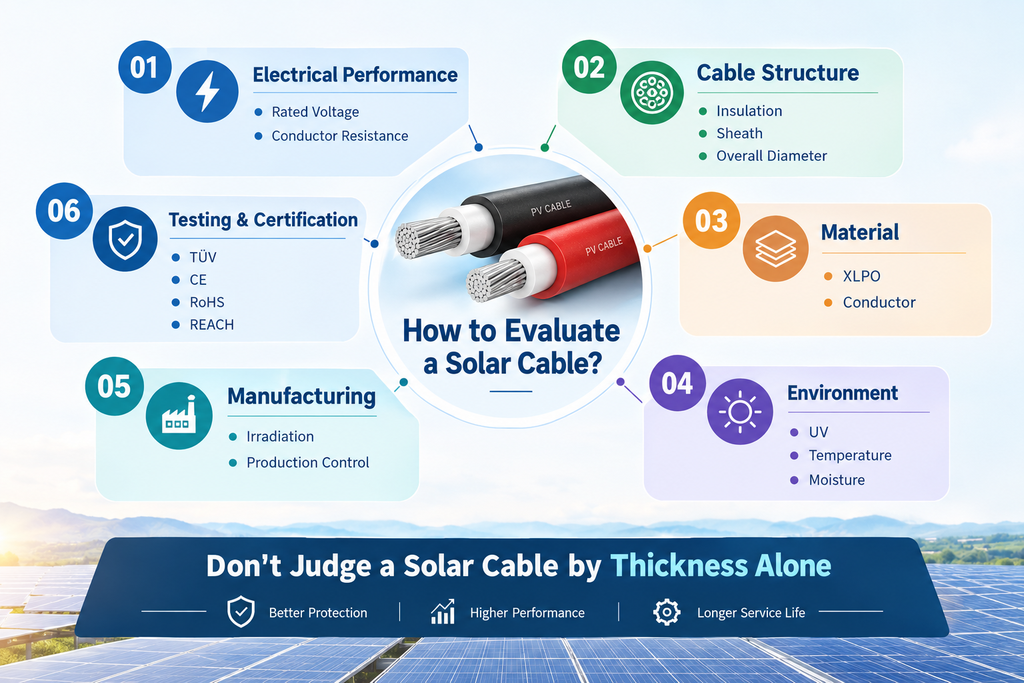
What Should You Compare When Buying Solar Cable?
When comparing different solar cables, thickness should be one factor—not the only factor.
A professional buyer should also consider the conductor resistance, rated voltage, cable cross-section, insulation and sheath materials, environmental resistance, manufacturing process, testing, and certification.
For projects with demanding outdoor conditions, it is especially important to understand how the cable is designed to handle long-term exposure to UV radiation, temperature changes, moisture, and mechanical stress.
Certification and test documentation are also important. Depending on the product and market, buyers may need to check requirements such as TÜV, CE, RoHS, REACH, EN 50618, or IEC 62930.
The exact requirements should always be checked according to the product specification, applicable standard, project requirements, and destination market.
In other words, a reliable solar cable should be evaluated as a complete product rather than judged by one specification.
Does a Thicker Solar Cable Have a Longer Service Life?
Not necessarily.
Service life depends on multiple factors, including material quality, UV resistance, temperature resistance, mechanical properties, irradiation quality, environmental conditions, installation method, product design, and manufacturing consistency.
A thicker sheath can provide additional physical protection, but it is only one factor among many.
This is why the better question is not:
“Which solar cable is the thickest?”
It is:
“Which solar cable has the right structure and materials for the intended application?”
That question allows project developers, EPC contractors, distributors, and installers to evaluate the cable based on actual project requirements rather than a single visible specification.
FAQ About Solar Cable Thickness
Is a thicker solar cable better?
Not necessarily. Cable performance depends on the complete structure, including the conductor, insulation, sheath, materials, manufacturing process, testing, and installation requirements.
How thick should solar cable insulation be?
The required insulation thickness depends on the cable standard, voltage rating, construction, and applicable product requirements. Buyers should evaluate the actual product specification and certification rather than assuming that thicker is always better.
Why does solar cable use XLPO?
XLPO is commonly used in photovoltaic cable insulation and sheaths because it is suitable for demanding outdoor applications and can provide important heat, UV, weather, and mechanical resistance.
Does solar cable need irradiation?
Irradiation cross-linking is widely used for high-performance photovoltaic cable materials. It can improve important material properties, but the actual manufacturing process and product specification should be evaluated.
What is reinforced solar cable?
Reinforced solar cable refers to a cable design that adds protection to one or more parts of the cable structure, such as the conductor, insulation, sheath, or overall cable structure. The exact construction should be confirmed through the product specification.
Conclusion: Better Solar Cable Design Is About Balance
So, is thicker solar cable really better?
Thickness can improve protection, but thickness alone does not define cable quality.
A well-designed photovoltaic cable needs the right balance between electrical performance, material selection, insulation, sheath protection, mechanical durability, manufacturing process, and installation requirements.
For VAZPO, reinforced solar cable is based on this principle: not simply making a cable thicker, but improving protection throughout the cable structure.
When selecting a solar cable for a long-term PV project, the better question is not how thick the cable is, but how well the entire cable is designed to perform in its intended environment.